Tradition, thoughtful teaching and modern tools
Greek.school was created to offer Greek-language and heritage education of an unusually high standard to children growing up outside Greece.
Why Greek.school exists
Greek.school grew from a desire to create something more substantial than conventional language tuition. For children of the Greek diaspora, learning Greek can also be a way of entering into family memory, history, faith, literature, music, customs and a living relationship with Greece.
Our founder is a graduate of the Anavryta Model School (Πρότυπος Σχολή Αναβρύτων), from the era of Konstantinos Gregoriadis, the school's theologian and headmaster. Gregoriadis wrote on tradition, education and the contribution of Patristic writings to teaching. That educational inheritance — seriousness of purpose, respect for tradition and an understanding of education as the formation of the whole child — has remained influential in the thinking behind Greek.school.
Konstantinos Gregoriadis was a theologian, educator and author of religious education textbooks used in Greek schools, including Η διδασκαλία του Κυρίου (The Teaching of the Lord), Η χριστιανική λατρεία (Christian Worship) and Η χριστιανική ηθική (Christian Ethics). His wider writings explored the relationship between Orthodox faith, education and the formation of the person, including Η εσχατολογική διάσταση στη μόρφωση του ανθρώπου (The Eschatological Dimension in Human Formation). His work reflects an understanding of education that embraces intellectual development alongside spiritual growth, personal responsibility and the deeper purpose of human life. In our teaching methods and curriculum, we endeavour to embrace these core principles of intellectual, spiritual and personal development.
A Greek tradition of παιδεία
For us, education is not simply the transfer of information. The older Greek idea of παιδεία concerns the formation and cultivation of the person through language, stories, family, culture, example and character. We want children not merely to complete exercises in Greek, but gradually to feel that Greek belongs to them.
An important inspiration is Saint John Chrysostom . In On Vainglory and How Parents Should Bring Up Their Children — translated into English in 1659 as The Golden Book of St. John Chrysostom, Concerning the Education of Children — he emphasises forming children from an early age, using carefully chosen stories, adapting teaching to the child's understanding, revisiting stories so that children remember and retell them, and involving the family in education.
Παιδεία: language, character and faith
At Greek.school, παιδεία means cultivating the person through language, stories, example, family and thoughtful practice. We draw inspiration from distinct Greek philosophical and Christian traditions, bringing selected principles into modern language teaching.
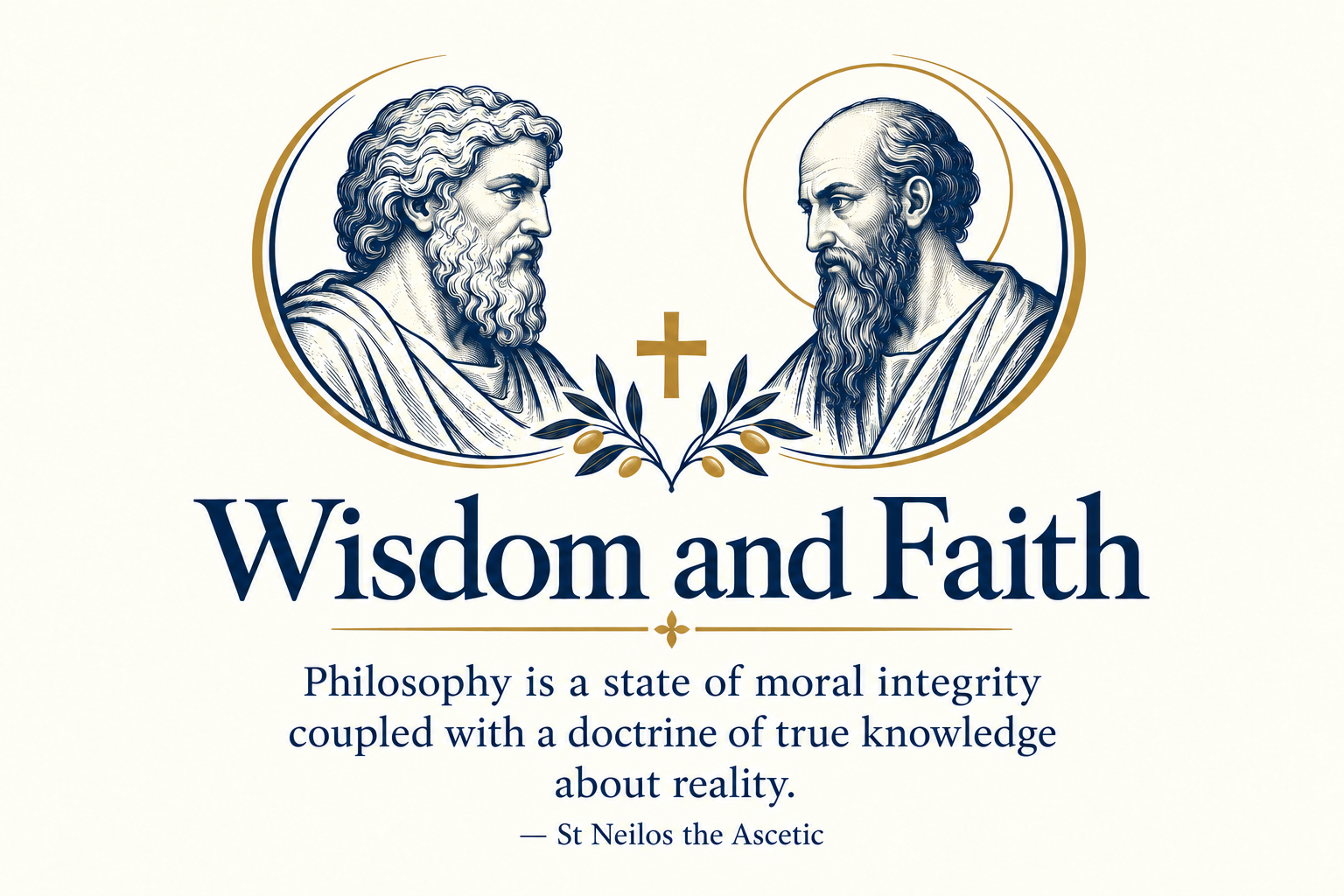
Saint Neilos the Ascetic, Ascetic Discourse, in The Philokalia, Volume I. English rendering used in our emblem.
| Inspiration | Educational emphasis | Our modern application |
|---|---|---|
| Aristotle — character through practice | Good character develops through repeated good actions and thoughtful choices. | Use stories to discuss courage, fairness and self-control; encourage children to practise these qualities in everyday life. |
| Clement of Alexandria — knowledge and goodness | Education includes moral and spiritual formation alongside intellectual learning. | Connect Greek reading and conversation with reflection on how we live and treat others. |
| Saint John Chrysostom — stories, example and family | Children learn through good example, carefully chosen stories, recollection, retelling and family involvement. | Read together, ask questions, offer clues, invite retelling and revisit the story with parents or grandparents. |
| Saint Gregory V — supporting education and Greek learning | Supported education and helped make Christian writings accessible through translation and publication. | Explain difficult ideas clearly and help families encounter Greek language and Christian heritage together. |
| Saint Cosmas of Aitolos — education reaching the community | Promoted schools, literacy, Greek learning and understanding of Orthodox faith, speaking in language ordinary people could understand. | Keep explanations approachable; support families and community schools with useful learning material and accessible routes into Greek. |
Saint Gregory V: valuing education
Saint Gregory V supported education and the circulation of Christian learning through translations and publications. We honour his contribution as a supporter of education; we do not attribute a separate classroom method to him.
Δεν υπάρχει τιμιότερο και ωφελιμότερο πράγμα σ’ αυτόν τον πρόσκαιρο κόσμο... από την σοφία και την παιδεία.
“There is nothing more honourable and more beneficial in this temporary world than wisdom and education.”— Saint Gregory V, Patriarch of Constantinople
Saint Cosmas: learning when resources are limited
Saint Cosmas worked among communities where access to schooling was limited. His priority was to encourage schools and learning: reading and writing, Greek, and an understanding of Orthodox faith. He urged parents to educate their children and used simple, direct language. For us, his example invites clear explanations, community involvement and practical support for learning when resources are limited.
A simple practice for families
Choose a short Greek story. Ask who acted, what they chose and why. Help the child retell it using a few useful Greek words. Return to the story next time, and invite a parent or grandparent to continue the conversation. Discuss good choices without shaming the child or demanding a particular personal response.
These historical sources inspire our approach. The classroom applications are our modern adaptations, guided by contemporary teaching practice, safeguarding and the programme agreed with each family.
Historical sources and further reading
- Aristotle, Nicomachean Ethics, Book II, chapter 1
- Clement of Alexandria, The Instructor, Book I, chapter 1
- Saint John Chrysostom, On Vainglory and How Parents Should Bring Up Their Children
- Ecumenical Patriarchate, Gregory V
- Saint Cosmas, selected teachings in the Greek Ministry of Education school textbook
- Saint Cosmas, Teachings V and VI
Traditional principles, modern teaching
Our aim is to combine traditional, tested approaches to education — including principles found in the educational thought of Saint John Chrysostom — with excellent contemporary language teaching. Children encounter Greek through conversation, books, stories, history, mythology, music, food, geography, Orthodox tradition and the experiences of their own families.
Technology and AI can be useful servants of that process. They can provide short practice between lessons, reinforce vocabulary, support listening and create personalised activities. But they do not replace the relationship between child, teacher and family. Human attention, example, encouragement and conversation remain at the centre.
What we want children to take with them
The ambition is not simply to take children through a Greek syllabus. We want them to acquire the language while developing confidence, curiosity and a lasting connection with Greece and their Greek heritage. A child should gradually be able to speak with family, understand stories, recognise places and traditions, ask questions about where they come from and feel that Greek culture is something living rather than remote.
That is why Greek.school brings together language, heritage and παιδεία .
Interested in learning with us?
For London families, our private teaching programme brings this approach into the home. For online learning, visit GreekLessons.online.