01
Family & grandparents
Names, relationships, family memories, visits to Greece and the language children need to take part in family life.
For children who need not only more Greek, but a stronger living connection between the language, their family and the wider inheritance of Greece.
A child may feel strongly connected to Greece while still lacking the Greek to speak freely with relatives, read a children’s book or explain what a family tradition means. Heritage Greek teaching starts from that reality. The language is taught through the child’s own connection to family, places, stories and everyday Greek life.
For some children the first goal is to answer a grandparent in Greek. For others it is to read, write and broaden a language they already speak. The programme can therefore begin from very different levels while keeping the same underlying purpose: to make Greek part of the child’s active life rather than something they merely recognise.
Names, relationships, family memories, visits to Greece and the language children need to take part in family life.
Athens, islands, villages, mountains and regions become a natural setting for vocabulary, description and conversation.
Age-appropriate myths, literature and historical episodes provide memorable material for listening, questioning and retelling.
The table, markets, ingredients, celebrations and ordinary routines create useful language that can continue at home.
Songs, visual culture, customs and celebrations allow children to encounter Greek beyond the textbook.
Feasts, churches, saints, prayers and related vocabulary can be explored when this reflects the family’s wishes.
Greek.school draws on the broader Greek idea of παιδεία: education as the cultivation of the person rather than the transfer of information alone. One historical voice that informs this approach is Saint John Chrysostom, whose writing on children gives particular importance to storytelling, memory, good speech, example and participation by the family.
We apply those principles in a modern and child-centred way. Children hear stories attractively told, answer questions, receive clues rather than immediate answers, return to material later and gradually retell more for themselves. The family is given simple ways to continue the language between lessons.
This is inspiration rather than historical imitation. Religious material is used according to the family’s preferences, and fourth-century prescriptions are not treated as modern teaching rules.
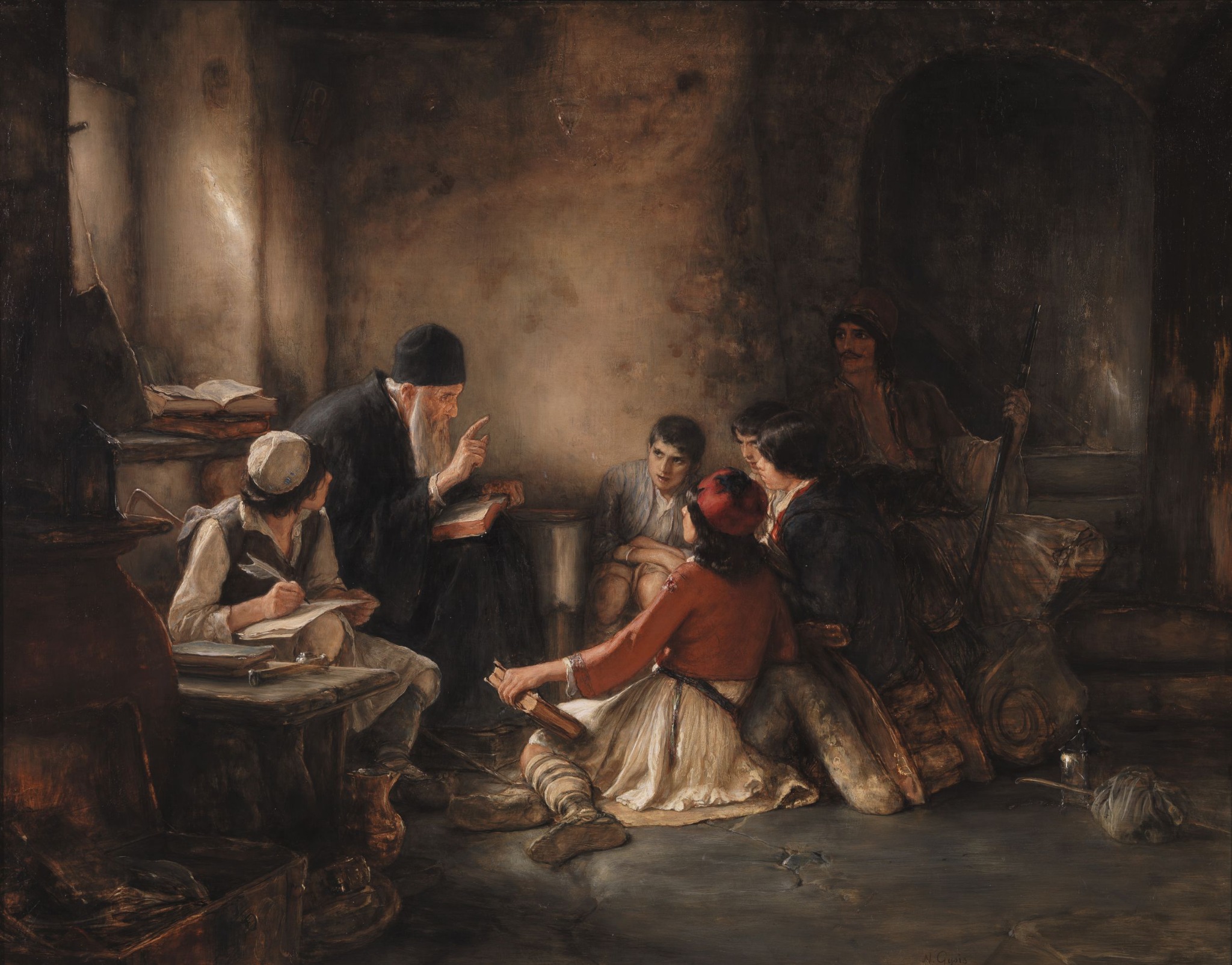
A tutor might tell or read a story, pause to ask what the child thinks will happen, teach a small number of useful Greek words, use a map or object, and ask the child to retell the important events at their own level.
The next lesson begins by retrieving that story before moving into a connected one. Repetition deepens rather than simply repeats.